> ## Documentation Index
> Fetch the complete documentation index at: https://docs-dev-docs-event-stream-action-templates.mintlify.site/llms.txt
> Use this file to discover all available pages before exploring further.
# Application Access to APIs: Client Grants
> Learn about Client Grants
In Auth0, you can control how applications access your APIs using [application API access policies](/docs/get-started/apis/api-access-policies-for-applications) and client grants.
A client grant provides fine-grained application access to an API. It associates:
* An API identified by its `audience` or unique identifier.
* An application identified by its `client_id`.
* A list of permissions such as scopes and/or `authorization_details_types` that the application is allowed to request for the specified audience.
To learn more about the list of attributes you can define in a client grant, read [Client grant attributes](#client-grant-attributes). To learn how to define and manage client grants, read [Create client grant](#create-client-grant).
## Application API access policies and client grants
When you configure an API's [application access policy](/docs/get-started/apis/api-access-policies-for-applications) to `require_client_grant`, only applications with a client grant defined can get an access token for the API. The client grant establishes the maximum permissions an application can request from the API by following the least privilege principle approach. As a result, Auth0 recommends using `require_client_grant` when configuring an API’s application access policy.
### Example: Social Media API
To illustrate how client grants follow the least privilege principle approach, say you have a Social Media API with the permissions: `read:posts`, `write:posts`, `read:friends`, and `delete:posts`. You create an application and define a client grant with the permissions: `read:posts` and `write:posts`.
This client grant now serves as a hard ceiling. Even though the Social Media API has other permissions, your application can never request or be granted `read:friends` or `delete:posts`.
## User-delegated access vs. client access
In user and client access, client grants define the final set of permissions that control an application’s access to an API. The client grant’s `subject_type` attribute determines the type of application access allowed for an API.
An application can have up to two client grants for a single API:
* When you set `subject_type` to `client`, you define its machine-to-machine permissions.
* When you set `subject_type` to `user`, you define its permissions to act on the user’s behalf.
The following table explains how client grants control application access to APIs based on the access type flow:
| Access type | subject\_type attribute | Description |
| ---------------------------------------------------- | ------------------------------- | --------------------------------------------------------------------------------------------------------------------------------------------------------------------------------------------------------------------------------------------------------------------------------------------------------------------------------------------------------------------------------------------------------------------------------------------------------------------------------------------------------------------------------------------------------------------------------------------------------------------------------------------------------------------------------------------------------------------------------------------------------------------------------------------------------------------------------- |
| Client credential access (Machine-to-machine access) | Set `subject_type` to `client`. | The client grant directly authorizes the application to access the API on its own behalf instead of the end user’s behalf. The permissions you define in the client grant are the ones the application is authorized to receive in the access token. |
| User-delegated access | Set `subject_type` to `user`. | The client grant defines the maximum permissions the application can request from the API. The final permissions in the access token issued to the application on the user’s behalf are the intersection of the permissions:
- Requested by the application
- Allowed by the client grant
- Allowed by [Role-Based Access Control policies](/docs/manage-users/access-control/rbac) for the user
- [Consented to by the end user](/docs/get-started/applications/third-party-applications/user-consent-and-third-party-applications), if applicable.
To learn more about user-delegated access flows, read [Authentication and Authorization Flows](/docs/get-started/authentication-and-authorization-flow). User-delegated access flows do not include the Client Credentials Flow. |
You can modify the final scopes granted by the authorization server to the application or user using [Actions](/docs/customize/actions).
## Client grant attributes
A client grant has several attributes that you can define to configure application access to APIs using the Auth0 Management API:
| Attribute | Description |
| ----------------------------- | ----------------------------------------------------------------------------------------------------------------------------------------------------------------------------------------------------------------------------------------------------------------------------------------------------------------------------------------------------------------------------------------------------------------------------------------------- |
| `id` | Unique identifier of the client grant. |
| `audience` | Unique identifier of the API the client grant is for. |
| `client_id` | The unique ID of the application that is being granted access. |
| `scopes` | An array of strings representing the permissions the application can request. |
| `authorization_details_types` | An array of strings representing rich authorization data types that the application can request. This attribute can only be specified for user-delegated access flows. |
| `subject_type` | The type of application access the client grant allows for:
- `user`: used for user-delegated access, which corresponds to all flows that generate a token associated with an end user.
- `client`: used for machine access, which corresponds to the Client Credentials Flow.
|
| `allow_all_scopes` | Boolean. Indicates if all scopes defined on the API are allowed for the application. For the API, future-defined scopes are automatically permitted. |
| `organization_usage` | Determines how the application may use Organizations when accessing the API via the Client Credentials Flow. Possible values are: `deny`, `allow`, or `require`.
To learn more about the Organization settings, read [Organizations for M2M Applications: Define Organization Behavior](/docs/manage-users/organizations/organizations-for-m2m-applications/configure-your-application-for-m2m-access#define-organization-behavior). |
| `allow_any_organization` | Determines whether the application can access any Organization when using the Client Credentials Flow.
To learn more about the Organization settings, read [Organizations for M2M Applications: Define Organization Behavior](/docs/manage-users/organizations/organizations-for-m2m-applications/configure-your-application-for-m2m-access#define-organization-behavior). |
## Create client grant
You can create:
* [Per-application permissions](#per-application-permissions): Apply granular permissions to each application in your tenant.
* [Default permissions for third-party applications](#default-permissions-for-third-party-applications): Apply default permissions to all third-party applications in your tenant.
When both exist for the same API, per-application permissions take precedence over default permissions for third-party applications.
### Per-application permissions
To configure per-application permissions using the Auth0 Dashboard:
1. Navigate to [Dashboard > Applications > APIs](https://manage.auth0.com/#/apis) and select the API you want to configure application access for.
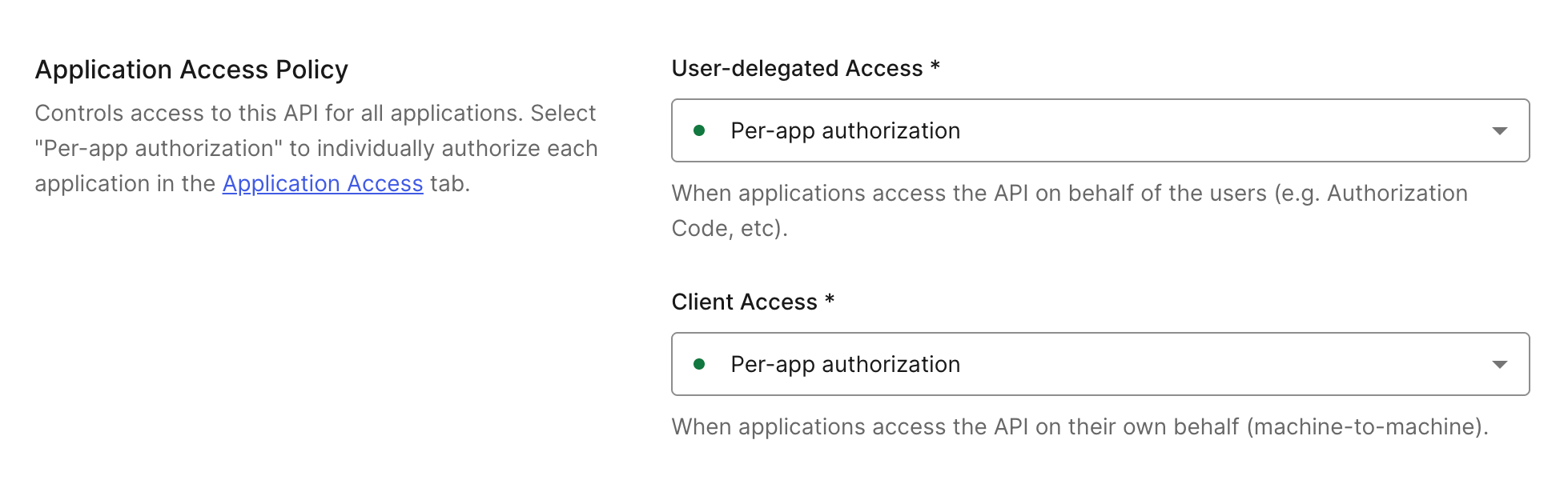
2. Go to the **Settings** tab and scroll down to **Application Access Policy**.
* Configure **User-Delegated Access** to **No apps allowed**, **Per-app authorization**, or **All apps allowed**.
* **No apps allowed**: No application can get an access token to the API.
* **Per-app authorization**: Only applications with a client grant defined can get an access token for the API.
* **All apps allowed**: Any application in your tenant can get an access token to the API.
* Configure the **Client Access** to **Per-app authorization** or **All apps allowed**.
* **Per-app authorization**: Only applications with a client grant defined can get an access token for the API.
* **All apps allowed**: Any application in your tenant can get an access token to the API.
3. Select **Save** to save the **Application Access Policy** settings.
 For per-application permissions, you need to individually authorize API access for each application.
1. Navigate to **Applications > APIs** and select the API.
2. Go to the **Application Access** tab.
3. Scroll to the application, select **Edit**, and then **Grant Access** for **User-Delegated Access** and/or **Client Access**. Then, select your desired permissions.
4. Select **Save**.
For per-application permissions, you need to individually authorize API access for each application.
1. Navigate to **Applications > APIs** and select the API.
2. Go to the **Application Access** tab.
3. Scroll to the application, select **Edit**, and then **Grant Access** for **User-Delegated Access** and/or **Client Access**. Then, select your desired permissions.
4. Select **Save**.
 Make a [`POST`](https://auth0.com/docs/api/management/v2/client-grants/post-client-grants) request to the `/client-grants` endpoint with the following request body:
```bash lines theme={null}
curl --location 'https://{yourDomain}/api/v2/client-grants' \
--header 'Content-Type: application/json' \
--header 'Authorization: Bearer {YOUR_MANAGEMENT_API_TOKEN}' \
--data '{
"client_id": "{CLIENT_ID}",
"audience": "https://api.my-service.com",
"scope": [
"read:item"
],
"authorization_details_types":["payment"],
"subject_type": "user"
}'
```
### Default permissions for third-party applications
[Third-party applications](/docs/get-started/applications/third-party-applications) always require an explicit client grant to access any API, even when the API's [access policy](/docs/get-started/apis/api-access-policies-for-applications) is set to **Allow All**. To simplify management when you have many third-party applications or use [Dynamic Client Registration](/docs/get-started/applications/dynamic-client-registration), configure default grants or permissions that apply to all third-party applications automatically.
A default third-party client grant uses the `default_for` attribute instead of a `client_id`. You can also define per-application permissions by creating a client grant with a specific `client_id`. When both exist for the same API, per-application permissions take precedence.
System APIs (the Management API, My Account API, and others) do not support default third-party client grants. Third-party applications cannot be granted access to system APIs.
The `default_for` and `client_id` attributes are mutually exclusive. Each client grant must specify exactly one of them.
To learn how to configure API access policies for third-party applications, read [Configure Third-Party Applications](/docs/get-started/applications/third-party-applications/configure-third-party-applications#configure-api-access-policies).
To configure default permissions for third-party applications using the Auth0 Dashboard:
1. Navigate to [Dashboard > Applications > APIs](https://manage.auth0.com/#/apis) and select the API you want to configure application access for.
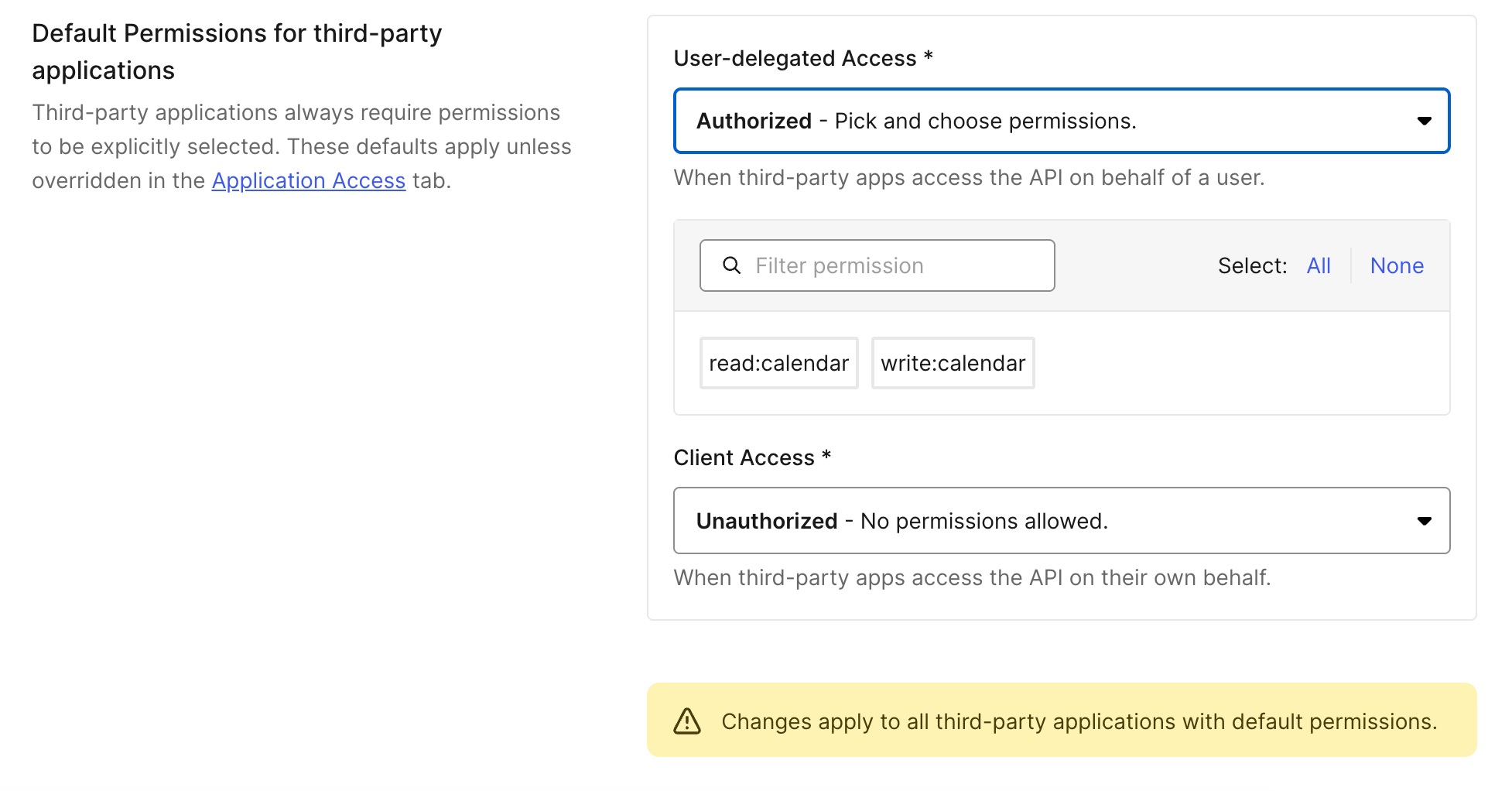
2. Go to the **Settings** tab and scroll down to **Default Permissions for Third-Party Applications**.
* Configure **User-Delegated Access** and/or **Client Access** to **Unauthorized**, **Authorized**, or **All**.
* **Unauthorized**: No permissions allowed.
* **Authorized**: Pick and choose permissions.
* **All**: Includes existing and future permissions.
3. Select **Save**.
Make a [`POST`](https://auth0.com/docs/api/management/v2/client-grants/post-client-grants) request to the `/client-grants` endpoint with the following request body:
```bash lines theme={null}
curl --location 'https://{yourDomain}/api/v2/client-grants' \
--header 'Content-Type: application/json' \
--header 'Authorization: Bearer {YOUR_MANAGEMENT_API_TOKEN}' \
--data '{
"client_id": "{CLIENT_ID}",
"audience": "https://api.my-service.com",
"scope": [
"read:item"
],
"authorization_details_types":["payment"],
"subject_type": "user"
}'
```
### Default permissions for third-party applications
[Third-party applications](/docs/get-started/applications/third-party-applications) always require an explicit client grant to access any API, even when the API's [access policy](/docs/get-started/apis/api-access-policies-for-applications) is set to **Allow All**. To simplify management when you have many third-party applications or use [Dynamic Client Registration](/docs/get-started/applications/dynamic-client-registration), configure default grants or permissions that apply to all third-party applications automatically.
A default third-party client grant uses the `default_for` attribute instead of a `client_id`. You can also define per-application permissions by creating a client grant with a specific `client_id`. When both exist for the same API, per-application permissions take precedence.
System APIs (the Management API, My Account API, and others) do not support default third-party client grants. Third-party applications cannot be granted access to system APIs.
The `default_for` and `client_id` attributes are mutually exclusive. Each client grant must specify exactly one of them.
To learn how to configure API access policies for third-party applications, read [Configure Third-Party Applications](/docs/get-started/applications/third-party-applications/configure-third-party-applications#configure-api-access-policies).
To configure default permissions for third-party applications using the Auth0 Dashboard:
1. Navigate to [Dashboard > Applications > APIs](https://manage.auth0.com/#/apis) and select the API you want to configure application access for.
2. Go to the **Settings** tab and scroll down to **Default Permissions for Third-Party Applications**.
* Configure **User-Delegated Access** and/or **Client Access** to **Unauthorized**, **Authorized**, or **All**.
* **Unauthorized**: No permissions allowed.
* **Authorized**: Pick and choose permissions.
* **All**: Includes existing and future permissions.
3. Select **Save**.
 Make a `POST` request to the `/api/v2/client-grants` endpoint with the following request body:
```bash cURL wrap lines theme={null} theme={null}
curl --request POST \
--url 'https://YOUR_DOMAIN/api/v2/client-grants' \
--header 'Authorization: Bearer YOUR_MANAGEMENT_API_TOKEN' \
--header 'Content-Type: application/json' \
--data '{
"default_for": "third_party_clients",
"audience": "https://api.example.com",
"scope": ["read:items", "write:items"],
"subject_type": "user"
}'
```
| **Parameter** | **Type** | **Description** |
| -------------- | -------- | --------------------------------------------------------------------------------------------------------------------------------------------------------------------------------------------------------------------------------------------------------------------------------------------------- |
| `default_for` | String | Specifies if this grant is automatically applied to certain app types. Set to `third_party_clients` to ensure all third-party apps have access to this API by default. |
| `audience` | String | The unique identifier (URI) of the API the grant is being created for. |
| `scope` | Array | A list of permissions (scopes) that are allowed as part of this grant. |
| `subject_type` | String | Defines the type of application access allowed for the API:
Make a `POST` request to the `/api/v2/client-grants` endpoint with the following request body:
```bash cURL wrap lines theme={null} theme={null}
curl --request POST \
--url 'https://YOUR_DOMAIN/api/v2/client-grants' \
--header 'Authorization: Bearer YOUR_MANAGEMENT_API_TOKEN' \
--header 'Content-Type: application/json' \
--data '{
"default_for": "third_party_clients",
"audience": "https://api.example.com",
"scope": ["read:items", "write:items"],
"subject_type": "user"
}'
```
| **Parameter** | **Type** | **Description** |
| -------------- | -------- | --------------------------------------------------------------------------------------------------------------------------------------------------------------------------------------------------------------------------------------------------------------------------------------------------- |
| `default_for` | String | Specifies if this grant is automatically applied to certain app types. Set to `third_party_clients` to ensure all third-party apps have access to this API by default. |
| `audience` | String | The unique identifier (URI) of the API the grant is being created for. |
| `scope` | Array | A list of permissions (scopes) that are allowed as part of this grant. |
| `subject_type` | String | Defines the type of application access allowed for the API:
- `user`: Used for user-delegated access, which corresponds to flows that generate a token associated with an end-user.
- `client`: Used for machine-to-machine access, such as the Client Credentials Flow.
|
## Update client grant
To update an existing client grant, make a [`PATCH`](https://auth0.com/docs/api/management/v2/client-grants/patch-client-grants-by-id) request to `/client-grants/{id}`:
```bash lines theme={null}
curl --location --request PATCH 'https://{yourDomain}/api/v2/client-grants/{CLIENT_GRANT_ID}' \
--header 'Content-Type: application/json' \
--header 'Authorization: Bearer {YOUR_MANAGEMENT_API_TOKEN}' \
--data '{
"scope": [
"read:item",
"update:item"
],
"authorization_details_types":["payment", "credits_transfer"]
}'
```
## Delete client grant
To delete a client grant, make a [`DELETE`](https://auth0.com/docs/api/management/v2/client-grants/delete-client-grants-by-id) request to `/client-grants/{id}`:
```bash lines theme={null}
curl --location --request DELETE 'https://{yourDomain}/api/v2/client-grants/{CLIENT_GRANT_ID}' \
--header 'Authorization: Bearer {YOUR_MANAGEMENT_API_TOKEN}'
```
## Retrieve client grants
You can also query and paginate through the `client-grants` collections by using parameters like `client_id`, `audience`, or `subject_type`:
```bash lines theme={null}
curl --request GET \
--url 'https://{yourDomain}/api/v2/client-grants?subject_type=user&audience=https%3A%2F%2Fapi.my-service.com' \
--header 'Authorization: Bearer {YOUR_MANAGEMENT_API_TOKEN}' \
--header 'Accept: application/json'
```
## Learn more
* [API Access Policies for Applications](/docs/get-started/apis/api-access-policies-for-applications)
* [Application Grant Types](/docs/get-started/applications/application-grant-types)
* [Third-Party Applications](/docs/get-started/applications/third-party-applications)
* [Configure Third-Party Applications](/docs/get-started/applications/third-party-applications/configure-third-party-applications)